
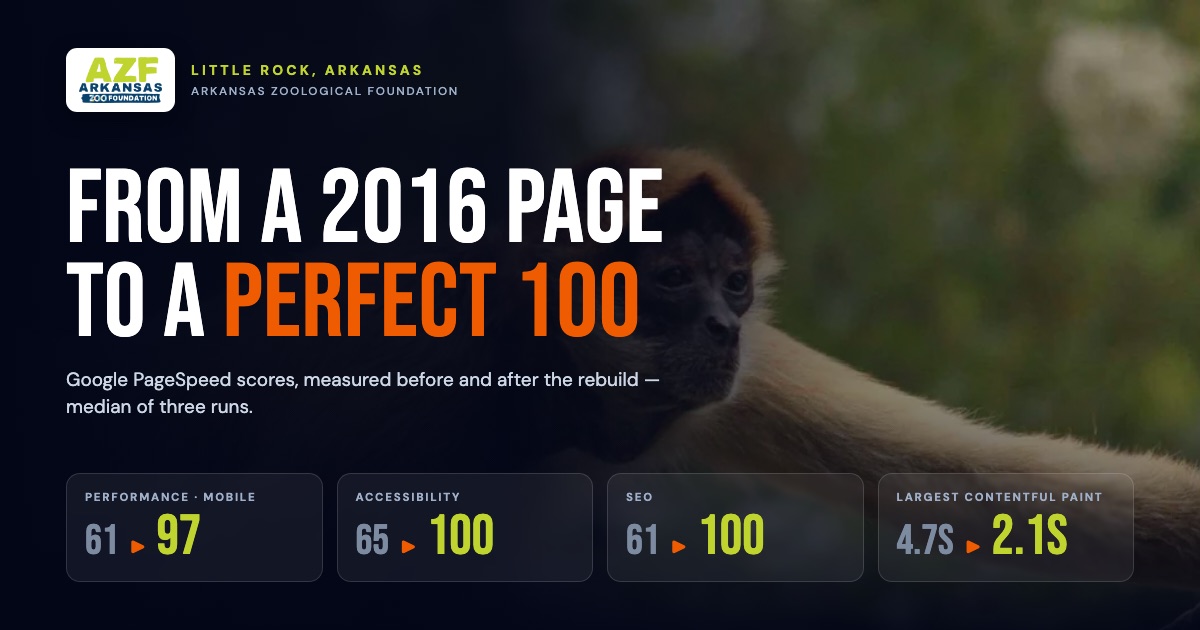
The Arkansas Zoological Foundation raises the private money behind the Little Rock Zoo — new habitats, animal care, conservation education for kids across the state. In September 2026 we replaced their website. The old one had a copyright notice that read 2016.
That is not a slight against the Foundation. It is what happens to almost every small-organization website: it gets built, it works, and then ten years go by. What we want to show you here is what actually changed — not in adjectives, but in Google's own numbers, measured the same way on the old site and the new one.
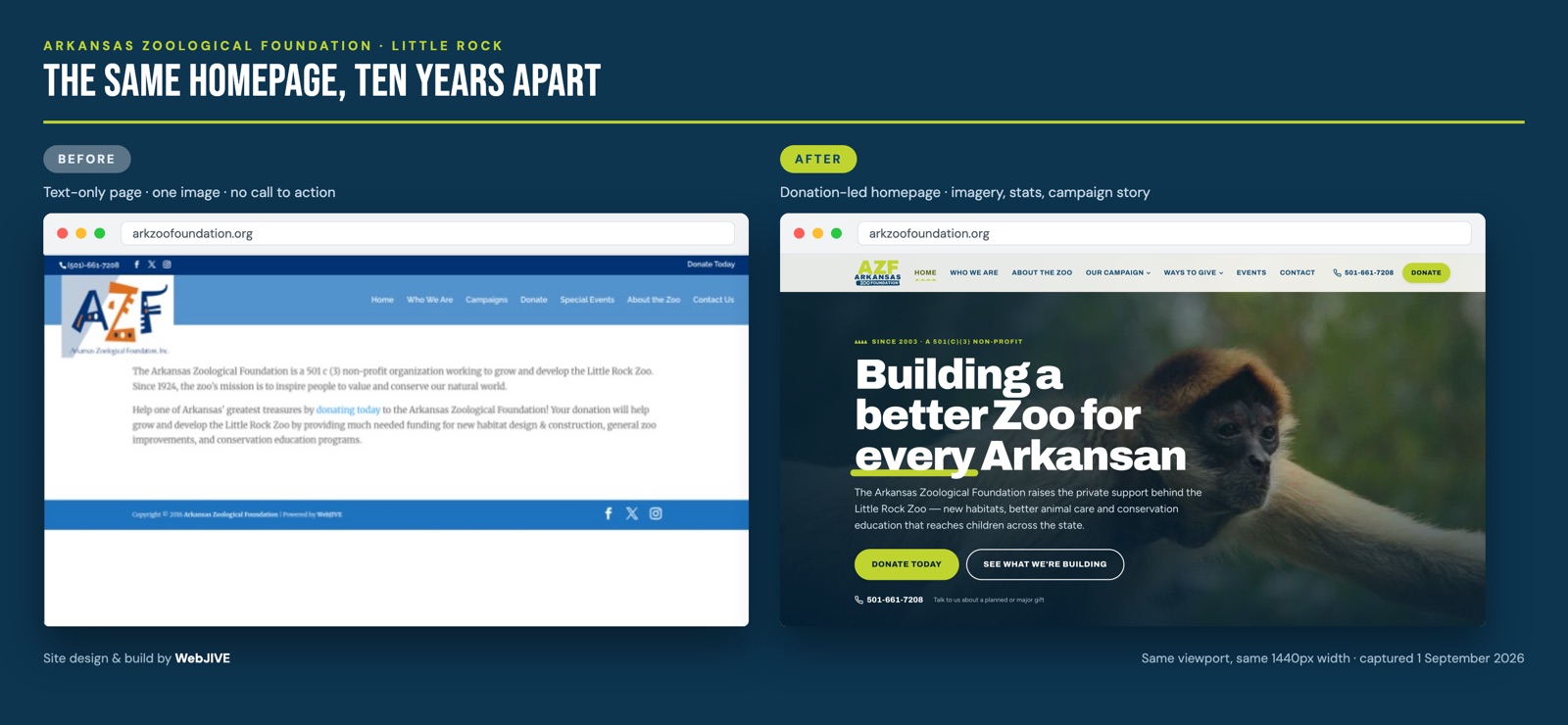
What “stale” actually looked like
The old site ran WordPress with the Divi page builder and eight plugins on top. Behind it sat 208 MB of uploaded media and a 472 MB install. All of that machinery was in service of a homepage that contained, in full:
- A navigation bar and a logo from before the Foundation's 2025 rebrand
- Two paragraphs of text
- One image
- A footer reading “Copyright © 2016”
No photography of the Zoo or its animals. No mention of the $12 million capital campaign that was already underway. No donate button above the fold — just the words “donating today” hyperlinked mid-sentence, with a typo in them. An organization in the middle of the biggest fundraising push in the Zoo's history had a website that never asked.
The scores, before and after
Here is the part most redesign write-ups skip, because it requires actually measuring the old site instead of describing it. Before we retired the WordPress build, we stood it back up on a private host — same server, same PHP, same database — and ran Google PageSpeed Insights against it. Then we ran the identical test against the live rebuild. Same four pages, same day, median of three runs each, mobile and desktop.
Mobile
| Page | Performance | Accessibility | SEO | LCP | Layout shift |
|---|---|---|---|---|---|
| Home | 61 → 97 | 65 → 100 | 61 → 100 | 4.7s → 2.1s | 0.19 → 0 |
| Who We Are | 70 → 98 | 78 → 100 | 61 → 100 | 4.4s → 2.3s | 0.12 → 0 |
| Our Campaign | 66 → 96 | 65 → 100 | 54 → 100 | 5.0s → 2.2s | 0.13 → 0 |
| Donate | 68 → 95 | 66 → 100 | 54 → 100 | 4.4s → 2.5s | 0.15 → 0 |
Desktop
| Page | Performance | Accessibility | SEO | LCP |
|---|---|---|---|---|
| Home | 97 → 100 | 76 → 100 | 61 → 100 | 0.9s → 0.5s |
| Who We Are | 93 → 100 | 85 → 100 | 61 → 100 | 0.9s → 0.6s |
| Our Campaign | 96 → 100 | 76 → 100 | 54 → 100 | 0.9s → 0.6s |
| Donate | 98 → 100 | 76 → 100 | 54 → 100 | 0.9s → 0.5s |
Every page of the new site scores 100 for Performance, Accessibility, Best Practices and SEO on desktop, and 95–98 on mobile with perfect 100s across the other three categories.
Be honest about the baseline
Desktop performance on the old site was already 93–98. If we only showed you desktop speed, we would be taking credit for very little. The old site was fast on desktop for the same reason it was failing everywhere else: there was almost nothing on it.
The real movement is in the three columns that measure whether a site works for actual people and actual search engines — mobile speed, accessibility and SEO — and in the layout shift, which went from a visibly jumpy 0.19 to a flat zero.
Twice the page, half the wait
The new homepage is heavier than the old one: about 1.4 MB against 703 KB, because it now carries real photography of the Zoo's animals instead of a single logo. It still paints its largest element in less than half the time.
That is the whole argument for how we build. Speed is not about shipping less — it is about not shipping a page-builder, a theme framework, a plugin stack and a database query for every visitor who just wants to find the donate button. The rebuild is flat files:
- No database, no page builder, no plugins. Pages are served as static HTML. There is no render step between the visitor and the content.
- Self-hosted variable fonts (Archivo and Figtree, matching the Foundation's 2025 rebrand) instead of third-party font requests.
- Art-directed responsive images. The hero is two separately cropped WebP files served through
<picture>— a wide crop for desktop, a tall one for phones — so a phone never downloads a 5,184-pixel-wide photograph. - Explicit dimensions on everything. That is the entire reason layout shift is 0.00 rather than 0.19: nothing on the page moves after it appears.
The part nobody sees: not losing ten years of search equity
A redesign is the easiest way in the world to quietly destroy a site's rankings. Rename the pages, and every link and every indexed URL Google has learned over a decade points at a 404.
So we kept every slug exactly as it was — /who-we-are/, /current-campaign/, /donate/, /memorial-trees-bricks-benches/ and the rest. Then we checked the old sitemap, and this is where it got interesting: WordPress had nine real pages but 42 indexed URLs. The other 33 were attachment permalinks — a page WordPress silently generates for every uploaded image — plus one page indexed at a nested address the new build did not serve.
We wrote twelve redirect rules before the switchover and verified all 42 of 42 resolve with a 200 on the new site. Nothing that Google knew about was dropped on the floor.
We also checked what was in the old contact form database before deleting anything. It held zero leads — verified three separate ways, because the plugin was active and looked like it should have been storing them. Submissions had only ever gone out by email. Worth knowing for certain rather than assuming.
If your site is the stale one
The Foundation's website was not broken. Nobody had complained. It loaded, it said true things, and the phone number was correct. That is exactly what makes this kind of site so easy to leave alone for a decade — and it is why the numbers above are worth running on your own site before you decide it is fine.
A 2016 page in 2026 is not a design problem. It is a mobile-speed problem, an accessibility problem, and a search problem, and those three quietly cost you the visitors you never hear from.
See the full build in our Arkansas Zoological Foundation case study, browse more of our Arkansas web design projects, or read about our approach to web design in Little Rock. And if you would like to support the Zoo directly, the Foundation is at arkzoofoundation.org.
PageSpeed figures above were captured on 1 September 2026 using the Google PageSpeed Insights API, median of three runs per page and per strategy, scoring the canonical no-redirect URL.